
Introduction to Energy Models in Research
In this research, a first-order energy model is explored and mathematically defined through two primary equations. The energy required for transmitting and receiving data is crucial for understanding the energy dynamics within networks. Specifically, the energy consumption is categorized based on the distance of transmission, with different formulas applied depending on whether the distance falls below or exceeds a certain threshold. This threshold distance plays a significant role in determining energy efficiency in both short and long-range communications.
Network Initialization and Sensor Node Placement
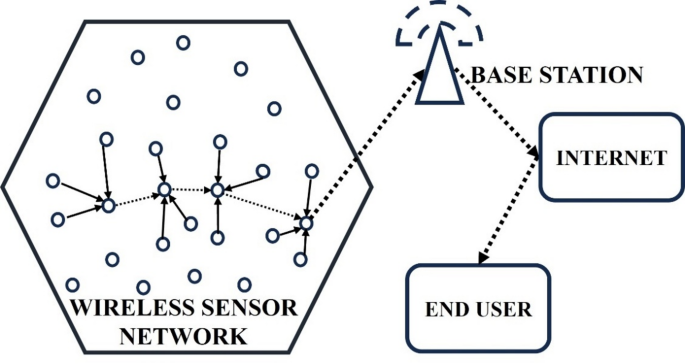
The implementation of this study begins with initializing the network, which is essential for effective monitoring and data collection. The strategic placement of sensor nodes is critical, as it influences network coverage, connectivity, and overall energy consumption. Initial parameters such as energy levels, memory capacities, and communication ranges for each sensor are established. Additionally, the formation of clusters at this stage significantly impacts the efficiency of data collection and routing strategies. The network area is defined, with nodes randomly distributed within it, which sets the groundwork for further analysis.
Cluster Formation and Initial Parameters
The initial conditions for the sensors within the network are organized according to a specified equation that assigns each node an initial energy level. This assignment of energy is integral to the functioning of the network, as it determines how effectively each node can operate over time. The creation of clusters is guided by a mathematical expression that defines the optimal percentage of cluster heads, thus ensuring that the network operates efficiently without overburdening any single node.
Cluster Head Selection Algorithms
After the initialization phase, the focus shifts to selecting cluster heads (CHs) using Particle Swarm Optimization (PSO) and Grey Wolf Optimization (GWO) algorithms. These methods take into account the distance of nodes from the base station and their remaining energy to establish a fitness function. This fitness function helps in identifying the most suitable nodes for the role of CHs, optimizing the network’s performance by balancing energy consumption and distance to the base station.
Fine-Tuning Cluster Head Selection
Following the initial selection of CHs through PSO, GWO is employed for further refinement. This optimization process utilizes the social hierarchy and hunting strategies of wolves to enhance the selection of cluster heads. The method updates the positions of potential CHs based on their relative distance to the best-performing nodes, ensuring that the final selection is both efficient and energy-conscious.
Data Collection and Compressive Sensing Techniques
Once the cluster heads are established, data acquisition commences using compressive sensing techniques. This approach reduces the volume of raw data gathered, thereby minimizing the computational burden for subsequent processing. By lowering data dimensionality, compressive sensing effectively lessens the required storage capacity and streamlines data handling procedures.
Reconstruction of Original Data
The reconstruction of the original datasets is achieved through the Smoothed Projected Landweber (SPL) method, which enhances the accuracy and speed of recovery. This method iteratively refines predictions based on previous data, ensuring that the original signals are recovered with minimal information loss. The iterative nature of this process also contributes to improving the overall quality of the recovered signals.
Data Compression with Huffman Coding
Subsequent to data reconstruction, Huffman coding is employed to further compress the data. This adaptive technique adjusts to changing data distributions by encoding differences between successive measurements, thus reducing the size of the transmitted data packets. Such compression not only conserves energy during transmission but also optimizes memory usage by minimizing the size of the Huffman tree.
Dynamic Path Recovery for Data Transmission
As data transmission and routing methods are initiated, a dynamic path recovery mechanism works in tandem with the Opportunistic Energy-Efficient Routing Protocol (OEERP). This combination enhances the reliability and efficiency of data transmission by dynamically adapting paths based on current network conditions. In the event of network disruptions, such as node failures, the dynamic recovery system identifies alternative routes using a hybrid PSO and GWO approach.
Evaluation of Potential Routes
The optimization of routing paths is mathematically expressed through a fitness function that assesses potential routes based on energy balance, distance to the base station, and link quality. This function aids in selecting the most efficient paths for data transmission while considering the energy reserves of nodes.
Energy Management and Node Activation
The OEERP also plays a crucial role in managing node activation based on their energy levels and communication needs. This decision-making process determines whether nodes should enter sleep mode to conserve energy, ensuring that the network operates efficiently over time.
Transmission Power Calculation
The total power required for transmitting data packets is calculated based on the number of packets, energy consumed during transmission, and the distance between nodes. This calculation is vital for understanding the overall energy expenditure during data transmission, as it informs strategies for energy conservation.
Continuous Monitoring and Optimization
Continuous monitoring of network conditions is implemented to assess adaptability and enhance performance. This monitoring collects real-time data on various network parameters and guides decisions regarding adjustments across the system. The optimization process is maintained through a feedback loop, ensuring dynamic adaptation to changing conditions to sustain optimal network performance.
Innovations in Hybrid Cluster Selection Framework
While the combination of PSO and GWO is recognized in optimization literature, the introduction of the NSPL-HCS framework brings forth significant advancements in energy-efficient and sparsity-aware clustering for wireless sensor networks (WSNs). This innovative framework employs a customized fitness function that considers residual energy, node density, and spatial sparsity, thereby improving clustering efficiency and data recovery. Additionally, it facilitates an adaptive transition between exploration and exploitation phases, enhancing convergence speed and solution diversity while maintaining low computational overhead, making it particularly suitable for resource-constrained IoT devices.


